
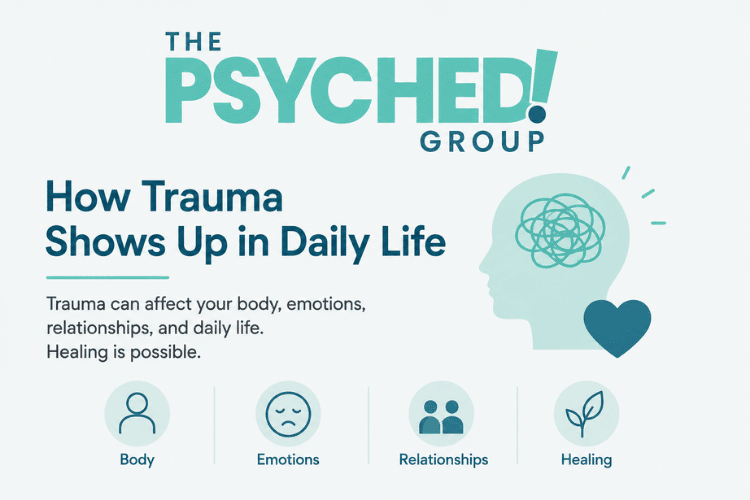
Trauma can shape daily life in ways that are easy to miss. Some people expect trauma to look like flashbacks or constant fear, but it often shows up as irritability, numbness, sleep problems, or feeling on edge for no clear reason. Others notice it in relationships, work performance, or the way their body responds to stress.
Trauma responses are not character flaws. They are protective adaptations, learned when your nervous system had to prioritize survival. Over time, those same protections can start to limit your freedom, your relationships, and your sense of self.
The Psyched Group works with adults and teens in Massachusetts who are navigating the effects of trauma, including experiences that may not have felt “serious enough” to count.
For an overview of available support, explore our trauma and PTSD therapy page, or read on to understand how trauma commonly shows up and what helps.
What Counts As Trauma
Trauma is not defined by the event itself but by how it was experienced and processed. A car accident, a difficult childhood, the sudden loss of a relationship, chronic stress, or repeated small violations of safety can all leave lasting imprints on the nervous system. The common thread is an experience that overwhelmed your capacity to cope at the time it happened.
Many people minimize their own trauma because they compare it to what they perceive as “worse” experiences. This comparison often delays healing. What matters clinically is not the severity of the event by some external standard, but how it continues to affect your functioning, relationships, and sense of safety.
Complex trauma refers to repeated or prolonged exposure to distressing events, often in childhood or within close relationships. It tends to affect identity, emotional regulation, and the ability to trust others in ways that single-incident trauma may not. Both forms are real and both respond to treatment.
Physical Signs of Trauma
The body often carries trauma before the mind fully recognizes it. Chronic tension in the shoulders, jaw, or chest, unexplained fatigue, digestive problems, headaches, and a heightened startle response are all common physical manifestations. These are not imagined. They reflect a nervous system that has learned to stay on alert.
Hyperarousal keeps the body in a state of readiness, as if danger is always nearby. This can feel like anxiety, restlessness, difficulty sitting still, or an inability to relax even in safe environments. Sleep is often disrupted because the nervous system does not fully downshift at night.
Hypoarousal, the opposite pattern, shows up as numbness, disconnection, fatigue, or feeling emotionally flat. Some people move between both states, feeling flooded and overwhelmed one moment and shut down the next. This oscillation is a hallmark of trauma’s effect on the nervous system.
Somatic approaches to trauma therapy, including body-based interventions, can be particularly helpful for physical trauma responses because they work directly with the nervous system rather than relying solely on verbal processing.
Emotional and Behavioral Patterns
Trauma frequently shows up as emotional dysregulation, where reactions feel disproportionate to the situation. A small conflict triggers intense anger. A minor setback produces despair. A neutral comment lands as a threat. These responses make more sense when understood as the nervous system pattern-matching to past danger rather than accurately reading the present moment.
Avoidance is one of the most common behavioral responses. People avoid people, places, topics, or feelings that remind them of the traumatic experience. While avoidance provides short-term relief, it reinforces the idea that those triggers are genuinely dangerous and prevents the nervous system from learning that safety is possible.
Difficulty trusting others, withdrawing from relationships, or becoming overly self-reliant are also common. Trauma, especially relational trauma, teaches the nervous system that closeness is risky. Rebuilding the capacity for connection is often a central part of trauma recovery.
How Trauma Affects Relationships
Trauma does not stay contained to the person who experienced it. It shows up in how people communicate, how they respond to conflict, how much closeness they can tolerate, and how they interpret the intentions of others. Partners, children, and close friends often feel the effects without understanding the source.
Attachment patterns shaped by early trauma can make adult relationships feel confusing. A person may simultaneously crave closeness and feel threatened by it. They may push partners away when things get too intimate, or become anxious and hypervigilant about signs of abandonment.
Trauma can also affect parenting. Parents who experienced childhood trauma may find certain behaviors in their children triggering, or may struggle to stay regulated during conflict. This is not a failure of love. It is a sign that the parent’s own healing matters, not just for themselves but for the next generation.
Effective Approaches to Trauma Treatment
Trauma-focused therapy has a strong evidence base. Approaches like EMDR, Cognitive Processing Therapy, and somatic therapies are designed to help the nervous system process what it was not able to process at the time of the original experience. The goal is not to erase the memory but to change its emotional charge and its hold on the present.
EMDR, or Eye Movement Desensitization and Reprocessing, uses bilateral stimulation to help the brain reprocess traumatic memories in a way that reduces their intensity. Many clients find that memories which once felt overwhelming become more like ordinary memories, present but no longer controlling.
The Psyched Group offers EMDR therapy for trauma as part of a comprehensive approach to healing. Therapy is paced to each client’s readiness and window of tolerance, ensuring that the process feels manageable rather than retraumatizing.
Recovery from trauma is not linear, and it does not require revisiting every painful detail. Many people make significant progress by learning to regulate their nervous system, building safety in the present, and gradually expanding what they can tolerate. If you are ready to explore support, search for a therapist today.
