

Ever felt your heart racing and pounding uncontrollably? You feel as if your heart will just jump out of your chest, and you feel a sudden wave of mixed feelings like regret, anxiety, and sadness all at once. Yup, this is called a panic attack, it might feel like it comes out of nowhere, but it has slowly yet gradually built up in your body and mind for quiet sometime. Unresolved emotions, feelings felt and words not delivered, all saved in a bottle in your mind that just can’t wait to get out, but just at the right time.
Most panic attacks send out quiet signals first, minutes before they actually peak. Learning to recognize the early signs of a panic attack gives you something incredibly powerful: a real window to act before it takes over. Here are the five to watch for.
Why Panic Attacks Aren’t as “Sudden” as They Feel
The feeling that a panic attack strikes “without warning” is honestly part of what makes it so terrifying.
A panic attack is your body’s fight-or-flight response firing when there’s no real danger. That response doesn’t switch on instantly; it builds, releasing adrenaline that produces physical sensations seconds to minutes before the peak.
Most people actually have a personal “pattern” the same one or two signs of a panic attack that show up first every time. Once you learn yours, you gain a head start. Coping techniques like grounding and controlled breathing work best when applied at the very first sign, before symptoms snowball. Catching it early can genuinely reduce how intense the attack becomes.
The Top 5 Early Warning Signs of a Panic Attack
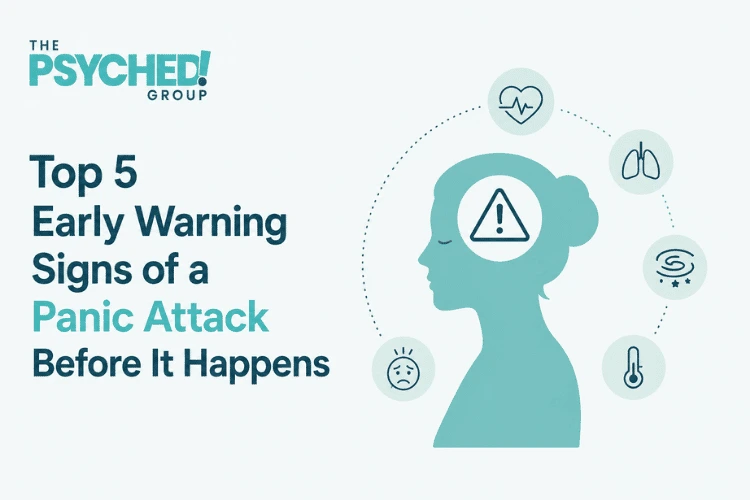
These are the five most common early signals the ones that tend to appear before a panic attack fully takes hold.
| Early Warning Sign | What It Feels Like |
| 1. Racing or pounding heartbeat | Heart suddenly speeds up or pounds, even at rest often the very first sign. |
| 2. Shortness of breath | Feeling unable to take a full breath; a tight or heavy chest. |
| 3. Dizziness or lightheadedness | The room feels unsteady; a floating or faint sensation, often from rapid breathing. |
| 4. Sudden temperature shift | Unexpected hot flashes, chills, or sweating with no environmental cause. |
| 5. Wave of dread or losing control | Sudden, disproportionate fear; a sense of impending doom or detachment. |
Not everyone gets all five, and they don’t always appear in the same order. But these are the panic attack symptoms reported most often in the lead-up to a full attack.
The Order These Signs Usually Appear In
Here are the 3 stages of Panic attacks; pattern recognition can help you catch what stage you might be in.
- Stage 1 — Physical signals first: Usually, it starts in the body, you can feel a racing heart, a tight chest, and breathlessness. These are easy to dismiss, which is why many people miss the window.
- Stage 2 — Cognitive shift: Next come the thoughts: “Something’s wrong,” “I can’t breathe,” “I need to get out.” Racing thoughts and catastrophic thinking accelerate the response.
- Stage 3 — Emotional flood: Then the wave of fear or dread hits, the sense of losing control or impending doom. By this point, the attack is usually peaking.
Basically, the earlier you catch it, the more effective your coping tools will be.
What to Do at the First Sign
The moment you notice your personal early sign, these evidence-based techniques can help.
- Slow your breathing: Breathe in for 4 counts, hold for 4, out for 6. Longer exhales signal your nervous system to stand down. This directly counters hyperventilation.
- Ground yourself (5-4-3-2-1): Name 5 things you see, 4 you can touch, 3 you hear, 2 you smell, and 1 you taste. Grounding pulls your focus out of the fear spiral and into the present.
- Name what’s happening: Telling yourself “this is a panic attack, it will pass, I am not in danger” reduces the fear-of-fear that fuels escalation.
- Don’t fight it or flee: Resisting or running from the sensations often makes them worse. Letting the wave rise and fall helps it pass faster.
These work best with practice, which is exactly what counseling for panic attacks helps you build. In a calm moment, they’re easy. Mid-attack, they take training.
What Triggers Panic Attacks and Can You Prevent Them?
Panic attacks usually do have a reason to surface, but sometimes that can be random. This might be due to some hidden triggers. Such as
- chronic stress and burnout
- major life changes
- excessive caffeine
- disrupted sleep
- underlying conditions like Generalized Anxiety Disorder
The question is, with such vast reasons for triggers, can they even be prevented?
Honestly, yes and no. They cannot always and entirely be prevented, but their frequency and intensity can often be reduced with a combination of trigger management and therapy. Such as identifying personal triggers, consistent sleep, stress reduction, and therapy. Cognitive Behavioral Therapy (CBT) doesn’t just manage attacks in the moment it addresses the thought patterns that keep the panic cycle going.
In short, it is not always fully preventable, but far more manageable than most people assume.
When to Seek Therapy for Panic Attacks
One panic attack doesn’t necessarily mean you need treatment. But if attacks are recurring, it’s a clear cue to reach out.
Recurring panic attacks can be a sign of Panic Disorder, a highly treatable condition. Counseling for panic attacks, especially CBT, is incredibly effective. Panic attack treatment in Massachusetts is available both in person and through virtual mental health therapy, making support accessible even when leaving the house feels difficult.
If you’re unsure whether what you’re experiencing is panic or something else, our guide on the difference between anxiety and panic attacks may help clarify.
Recognizing the signs is the first step. Learning to manage them for good is the next.
If panic attacks are showing up more often, or the fear of the next one is starting to shape your days, you don’t have to navigate it alone. Psyched Group’s licensed clinicians provide evidence-based counseling for panic attacks, including CBT for adults and teens, in person and virtually across Massachusetts.
Learn About Our Anxiety & Panic Therapy
FAQs
What Are the Earliest Warning Signs of a Panic Attack?
The earliest signs of a panic attack are usually physical, such as a sudden racing or pounding heartbeat, shortness of breath, dizziness, an abrupt shift in body temperature, and a wave of intense dread.
How Can I Tell if a Panic Attack Is About to Happen?
To tell if a panic attack is about to happen is through a cascade of signs. Starting with physical symptoms such as a racing heart, then cognitive thoughts like “I can’t breathe. Lastly, an emotional flood of fear hits.
Can Panic Attacks Be Prevented Before They Start?
Yes and no. Panic attacks can’t always be fully prevented, but their frequency and intensity can be significantly reduced by spotting the symptoms early on and through proper therapy.
What Triggers Panic Attacks in Adults?
Common triggers include chronic stress, major life changes, caffeine, poor sleep, specific phobias, and underlying conditions like Generalized Anxiety Disorder. They also sometimes appear as coping mechanisms.
When Should I Seek Therapy for Recurring Panic Attacks?
Seeking therapy is very necessary if you notice a change in you behavious like when you start avoiding places, or when they interfere with your sleep or relationships. When you become more introverted, avoid outings, and much more. A complete evaluation is provided by a licensed therapy provider or a clinician.
