

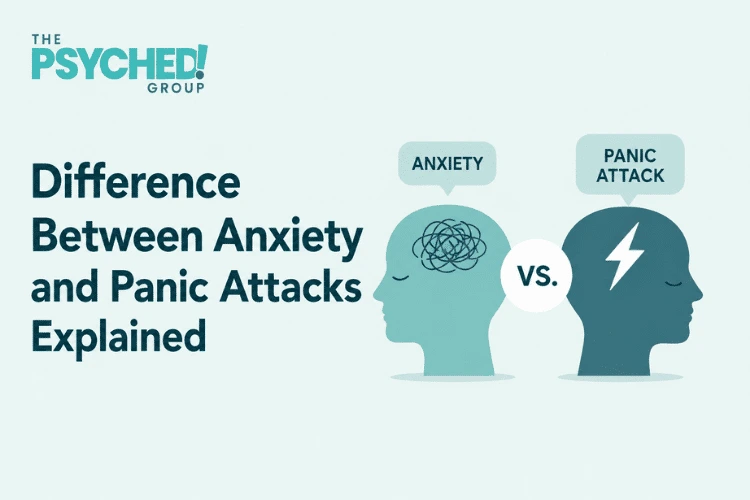
Your heart races. Your chest tightens. You can’t catch your breath. Is it a panic attack? An anxiety attack? Are they two different things?
For many people, this confusion is part of the distress itself. Understanding the difference is the first step toward the right anxiety treatment, navigating effective panic attack treatment, or exploring comprehensive anxiety disorder treatment and toward feeling like yourself again.
Why People Confuse Anxiety and Panic Attacks
Here’s something most people don’t know, and it explains the whole confusion. When people say “anxiety attack,” they’re usually describing a wave of intense anxiety, or sometimes what is actually a panic attack.
A panic attack, by contrast, is a sudden surge of intense fear that peaks within minutes, with at least four physical symptoms. The two feel similar in the moment, but they have different patterns, durations, and sometimes different treatment approaches. Getting clear on which you’re experiencing is what makes anxiety treatment effective rather than guesswork.
The Key Differences
Here is the clearest side-by-side comparison of how anxiety and panic attacks actually differ.
| Factor | Anxiety Attack | Panic Attack |
| Onset | Builds gradually | Sudden, often without warning |
| Trigger | Usually tied to a stressor or worry | Can occur with no apparent cause |
| Intensity | Mild to severe | Intense, overwhelming |
| Duration | Can persist for hours or longer | Peaks within minutes, usually under 30 |
| Physical symptoms | Tension, restlessness, fatigue | Racing heart, chest pain, shortness of breath |
| Core feeling | Persistent dread or worry | Sense of immediate danger or losing control |
| Clinical status | Symptom of anxiety disorders | Defined diagnosis in DSM-5-TR |
The simplest way to remember it: anxiety is the slow build of worry about something that might happen. A panic attack is the body’s alarm system firing, sometimes even when there’s no real danger at all.
Panic attacks are often mistaken for heart attacks. In fact, many people end up in the ER only to learn their heart is fine. That’s how physically real they feel. Panic attacks usually subside within a few minutes, while anxiety symptoms can persist for long periods panic attacks can occur without a trigger, whereas anxiety usually occurs in response to a perceived stressor.
The Most Common Shared Symptom
Despite their differences, anxiety and panic attacks share one symptom: a racing or pounding heartbeat.
This is driven by the body’s fight-or-flight response. Whether anxiety builds slowly or panic strikes suddenly, the surge of adrenaline speeds up the heart. Other overlapping symptoms include shortness of breath, muscle tension, sweating, and a sense of dread.
Because the physical sensations feel so similar, many people genuinely can’t tell which they’re experiencing in the moment.
Which is exactly why a professional assessment is so helpful in guiding the right anxiety treatment.
Can You Have Both?
Short answer: yes, and it’s remarkably common. Many people experience both.
Someone with Generalized Anxiety Disorder may experience persistent, hard-to-control worry and may also experience panic attacks during periods of heightened stress. Repeated, unexpected panic attacks can be a sign of Panic Disorder, a distinct condition.
You can’t always self-diagnose from symptoms alone, and you don’t have to. A clinician maps when symptoms appear, how long they last, whether there’s a trigger, and how often they happen. Knowing whether you’re dealing with GAD, panic disorder, or both is what shapes effective anxiety disorder treatment.
How Anxiety and Panic Attacks Are Treated
The good news is that both anxiety and panic attacks are highly treatable. Most effective anxiety treatment combines a few evidence-based approaches.
Cognitive Behavioral Therapy is the most evidence-backed treatment for both. It helps to identify and reframe the thought patterns that fuel anxiety, and teaches practical tools to manage symptoms in the moment.
For panic disorder, gradually and safely facing feared sensations helps reduce the fear response over time, a core part of effective panic attack treatment.
Stress reduction, regular exercise, and improved sleep all support recovery.
For some people, medication is a helpful part of anxiety disorder treatment, always a decision made carefully with a qualified clinician.
There’s no single “best” treatment for everyone the most effective plan is matched to your specific symptoms.
CBT, Therapy, and Getting Help in Massachusetts
Yes, CBT is one of the most effective, well-researched treatments for both anxiety and panic disorders. It works by changing the thought-and-response patterns that keep the cycle going.
In practice, CBT involves identifying the thoughts that trigger anxiety, learning to challenge and reframe them, and building in-the-moment coping skills, like in this journal what CBT is and how it works.
Effective anxiety therapy in Massachusetts is available both in person and through virtual sessions. Telehealth has made consistent, high-quality panic attack treatment far more accessible.
You don’t have to figure out what’s happening on your own. Clarity and relief are possible.
If the experiences described here feel familiar, you deserve answers and support. Whether it’s anxiety, panic attacks, or both, effective treatment exists, and it works. Psyched Group offers evidence-based anxiety and panic disorder treatment for adults and teens, including CBT and virtual options across Massachusetts.
Learn About Our Anxiety Therapy Services
FAQs
What is the difference between a panic or anxiety attack?
The main difference is onset, intensity, and duration. A panic attack comes on suddenly and intensely, often without warning and peaks within minutes. Anxiety builds gradually, usually in response to a stressor, and can last much longer.
How can I determine if I have anxiety or panic attacks?
Clinicians look at the pattern: anxiety tends to build gradually in response to a stressor and last longer, while panic attacks come on suddenly, peak within minutes, and can occur without any clear trigger.
What is the most common symptom of anxiety and panic attacks?
The most common shared symptom of both anxiety and panic attacks is a rapid or pounding heartbeat, driven by the body’s fight-or-flight response.
What is best for treating anxiety and panic disorders?
The best anxiety treatment usually combines evidence-based therapy with supportive lifestyle changes. Cognitive Behavioral Therapy (CBT) is the most researched and effective approach for both, helping people reframe anxious thought patterns.
Can cognitive behavioral therapy be used to treat anxiety and panic disorders?
Yes, CBT works by helping people challenge and reframe anxious thoughts and build practical in-the-moment coping skills.
