
Your teenager comes home from school and disappears into their room. No blow-up, no drama — just silence. For a lot of Massachusetts parents, that’s what teen stress looks like now. Quiet. Hard to name. And it doesn’t always respond to “just talk to me about it.”
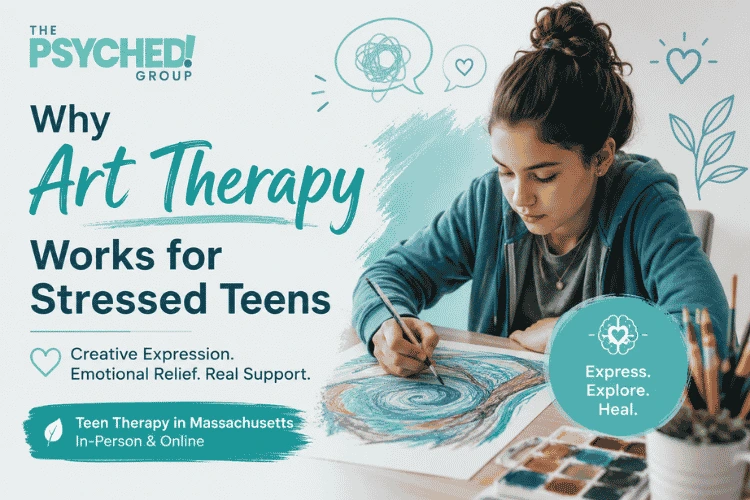
This is where art therapy fits into teen therapy. It gives teens a way to process what’s going on inside them without needing the right words right away.
Why Teens Experience Stress Differently
Teen stress hits differently because the teenage brain is still building the skills to manage big emotions. The prefrontal cortex — the part that handles planning and impulse control — isn’t fully developed until the mid-20s, while the emotional centers are already running at full speed. That mismatch is why a bad grade or a friend group falling apart can feel enormous.
Add in social media comparison, earlier academic pressure, mismatched sleep schedules, and constant notifications, and it’s no surprise teen stress often shows up as irritability, withdrawal, or a sudden drop in motivation, not a clear “I’m stressed.”
Talking about feelings requires already knowing what you feel and having the words for it. That’s a lot to ask of a developing brain under pressure — which is exactly where art therapy helps.
What Is Art Therapy?
Art therapy is a form of mental health treatment where a trained therapist uses drawing, painting, or collage to help someone explore emotions, process stress, and build coping skills.
It’s not an art class — nobody grades technique, and skill never matters. A licensed therapist guides the session with intention: asking a teen to draw how anxiety feels in their body, or build a collage of a hard week. Once something is on paper, it’s easier to talk about, because the teen is describing an image instead of explaining a feeling from scratch.
Quick summary: Art therapy pairs creative expression with clinical guidance. The goal isn’t the finished piece — it’s the insight and communication that happen while making it.
How Art Therapy Helps Teen Mental Health
- Lowers pressure to perform verbally. Teens who freeze up in conversation often loosen up with a creative task in front of them.
- Engages a different part of the brain. Working with your hands can pull attention away from anxious, looping thoughts.
- Reveals what’s really going on. Color choices and symbols often show patterns a direct question wouldn’t.
- Builds a visual record of progress over weeks and months.
- Supports regulation in the moment, similar to grounding techniques used in stress management work.
The Science Behind Creative Expression
Art therapy isn’t just a nice idea. Studies on creative arts therapies have found lower cortisol levels after brief art-making sessions, and research reviewed by groups like the American Psychological Association links creative expression to reduced anxiety and better mood regulation in adolescents. The National Institute of Mental Health also recognizes expressive therapies as effective complements to standard anxiety and depression treatment.
It’s not a replacement for evidence-based care — it works best alongside methods like CBT, guided by a licensed therapist.
Art Therapy Activities That Help Teens
- Emotion maps — coloring a body outline to show where stress shows up physically
- Collage work — arranging images or words to represent identity or a hard experience
- Pattern drawing (Zentangle) — repetitive, calming doodling with no skill required
- Before-and-after drawings — sketching a stressful moment, then how they wish it went
- Mask making — decorating the outside as how they present, the inside as how they feel
How Therapists Use Art During Teen Therapy
A session doesn’t start with “let’s paint.” It starts like any therapy session — checking in on the week and mood. From there, a therapist introduces a creative activity if it fits, using it deliberately rather than as a default:
- Check in on the week and stress level
- Identify an emotion or situation to focus on
- Introduce an art activity tied to that focus
- Give uninterrupted time to create
- Talk through the piece together
- Connect it to coping strategies for outside of session
Can Art Therapy Help Anxiety, Depression and Trauma?
Yes — as part of a broader treatment plan guided by a trained therapist. For anxiety, creative activities interrupt racing thoughts. For depression, art-making offers a low-pressure way to re-engage when a teen feels numb. For trauma, art can approach hard memories indirectly, which often feels safer than talking about them right away — an approach used in our trauma and PTSD support.
Art therapy isn’t a stand-alone cure, and it isn’t right for every teen. A licensed therapist should assess fit as part of an individualized plan.
Art Therapy vs Traditional Talk Therapy
| Talk Therapy | Art Therapy | |
|---|---|---|
| Main tool | Conversation | Creative activity plus conversation |
| Best for | Teens comfortable talking | Teens who struggle to find words |
| Skill needed | Willingness to talk | None |
| Common use | CBT, DBT, direct problem-solving | Emotional processing, trauma, expression |
Many teens do best with both: talk therapy for building skills like those used in behavioral therapy for teens, plus creative sessions when words aren’t enough.
How Parents Can Support Creative Healing
- Skip critiquing whether the art “looks good” — that’s not the point
- Ask open questions: “What’s going on in this part?” instead of “What does this mean?”
- Keep simple supplies at home, no pressure attached
- Protect unstructured downtime
- Model your own healthy coping — see our parenting support resources
When Should Parents Consider Teen Therapy?
Watch for sleep or appetite changes lasting more than two weeks, pulling away from friends, sudden grade drops, disproportionate irritability, talk of feeling worthless, or physical complaints with no medical cause.
If several of these show up together, or if there’s any talk of self-harm or suicide, reach out right away. The 988 Suicide & Crisis Lifeline is available 24/7. Otherwise, our child and teen therapy team can help you figure out next steps, including teen group therapy.
Benefits of Online Therapy for Teens
Online therapy for teens works well for creative approaches too:
- Teens join from a space where they already feel comfortable
- Home art supplies work just as well as an office
- No drive time after school or work
- Easier consistency during travel or busy seasons
Not every teen prefers virtual sessions — some do better in person, especially for trust-building. That’s why we offer both through online therapy across Massachusetts.
Finding Teen Therapy in Massachusetts
The Psyched Group works with teens and families across Massachusetts, both in person and online, blending creative approaches with evidence-based methods like CBT and DBT. Families can visit our East Bridgewater office or Middleborough office, or bring in the whole household through family counseling.
If school pressure or social stress is affecting your teen, see our guide on teen social anxiety and school avoidance, or check our FAQs page for questions about getting started.
Conclusion
Teen stress rarely announces itself clearly — it shows up in silence or a quiet retreat to a bedroom. Art therapy gives teens a way to process what they can’t yet say out loud, working best as one part of a larger, personalized care plan. If you’re not sure where to start, reaching out for a conversation is a low-pressure first step.
Frequently Asked Questions
What does art therapy do for teenagers?
It gives teens a non-verbal way to process stress, anxiety, and emotions they can’t easily put into words. A trained therapist uses the creative process to build self-awareness and practical coping skills.
Is art therapy effective for stress?
Yes. Research links creative activities like drawing and collage to lower cortisol levels and better emotional regulation, making art therapy a genuinely useful tool for everyday teen stress.
Can anxious teens benefit from art therapy?
Often, yes. Making something with your hands shifts focus away from racing, anxious thoughts and toward a hands-on task, which can support calmer regulation both during and after a session.
Does online teen therapy include creative therapies?
Yes. Teens can do art-based activities using supplies they already have at home, guided by a therapist over video, making it just as accessible as in-person creative work.
Is group therapy helpful for teenagers?
Yes. It shows teens they’re not alone in what they’re feeling and builds real social and communication skills in a supported setting, often alongside individual sessions.
