

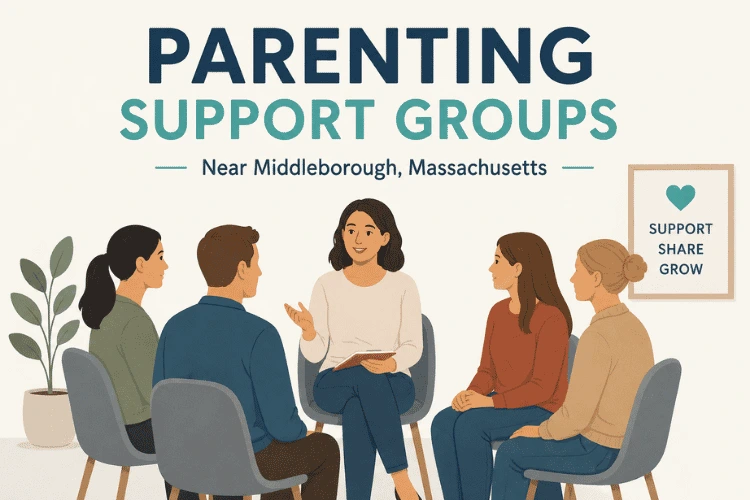
A few parents sit down together, same time every week, with a therapist or trained facilitator, and just talk about whatever’s going wrong at home. That’s really all a parenting support group is. You don’t need a crisis to justify showing up. Maybe you’re worn down. Maybe your kid hit some stage nobody warned you about and you want someone else’s take on it. A facilitator gives you something friends and family can’t always manage: a little distance, and tools that go past “it’ll pass.” Massachusetts parents have been asking about this more, and I get why. Between school pressure and screens and schedules that never let up, half the parenting advice our own parents got just doesn’t apply anymore.
So the short version: these groups blend other parents’ perspectives with actual clinical guidance. Some people want the group. Some just need a couple one-on-one sessions to work through one specific thing. Both count as parenting support services. Both exist near Middleborough.
What Are Parenting Support Groups?
There isn’t really a script for these. A check-in, some back and forth, one thing to try before next time, that’s usually it. It isn’t clinical therapy in the strict sense, although plenty of these groups are run by licensed therapists anyway. That detail matters more than it sounds, because who’s facilitating decides whether the group actually helps or just turns into everyone venting at each other.
Some run in person, weekly or every other week. Some are online for parents whose schedules don’t allow much wiggle room. Some are built around a stage, toddlers or teens, whatever fits your household. Single-parent groups exist for a different reason entirely, the specific weight of doing this without a partner in the room.
Benefits of Parenting Support Services
Nobody needs to be at their limit to get something out of this. Most people who show up just want backup. There’s genuinely something funny about hearing another parent describe the same meltdown your kid had on Tuesday, that little “oh thank god, it’s not just us” moment. Groups pass around strategies that actually worked in someone’s actual house, not something out of a book. A weekly check-in also creates a little accountability, and problems get caught small instead of turning into something bigger down the line.
They tend to work well next to other services too. When a kid’s dealing with anxiety, ADHD, or behavior stuff, families often run a parent group alongside child therapy or family counseling, so nobody’s working from a different playbook.
Challenges Parents Commonly Face
The list barely changes group to group: a kid’s big emotions without you losing yours, rules that stick even when co-parents disagree, work versus actual time with your kids, a teenager who’s suddenly gone quiet, guilt over “not doing enough” on days that were fine. None of this means anyone’s failing. It’s just what parenting is, most weeks, and it’s exactly what these groups exist for.
How Therapy Improves Parent-Child Communication
Most tension at home has nothing to do with love. It’s a gap in how people are talking, or not talking. Therapy works on hearing the feeling under a kid’s words rather than reacting to the words themselves, setting limits without the heat of the moment attached, offering choices that fit their age, and fixing things after a bad moment instead of leaving it. Family counseling leans on these same skills, and a lot of parents notice something shift within a handful of sessions.
Support for Single Parents
There’s a specific exhaustion that comes from doing this solo. No one to tag in on a bad night. Every decision, small or huge, lands on one person, every time. Single parent groups exist for exactly that reason, and people trade real fixes there, childcare gaps, scheduling messes, plain burnout. Topics that keep coming up: co-parenting communication after a split, custody transitions, rebuilding some kind of support system from nothing. Our piece on co-parenting after separation covers more of that ground if it applies.
Parenting Through Life Transitions
A new baby throws things off. So does a move, a divorce, a kid starting middle school. None of it has to be bad to knock a family’s rhythm sideways for a while. Support during those stretches usually comes down to keeping some routine for the kids, talking about the change in a way that fits their age, and noticing if a child’s struggling more than they’re letting on. It’s easy to forget the parent is going through the same shift, not just the kid.
Emotional Wellbeing of Parents
Parents are almost always the last ones to ask for help, even though their stress bleeds into everything else in the house. Watch for being on edge more than usual, losing patience faster than you used to, or feeling checked out even while you’re sitting right there. Taking care of your own wellbeing isn’t separate from being a good parent, it is being a good parent. Our stress management page is a fair starting point if burnout’s the real problem underneath everything else.
When to Seek Professional Help
Some things really do need more than a group setting. Reach out to a therapist directly if conflict at home keeps getting worse, if your child’s anxiety or behavior has you worried, or if you’re overwhelmed more days than not. A therapist can sort out the right mix, parenting support, teen therapy, family sessions, whatever fits. The CDC lists consistent, supportive parenting relationships as one of the strongest protective factors for a kid’s development, and that’s really the whole reason any of this support exists.
Choosing the Right Parenting Counselor in Massachusetts
Check that whoever you’re seeing is actually licensed and has worked with parenting or family issues specifically, not just general counseling. Make sure the format works, in-person if you want it, online if that’s easier. And be honest with yourself about whether you’d actually open up to this person without feeling judged. The Psyched Group runs both in-person sessions near Middleborough and online sessions across Massachusetts, so pick whichever one fits your actual week.
Conclusion
Raising kids is hard. That’s it, that’s the sentence. Needing support along the way doesn’t mean you’re getting it wrong. Parenting support groups and services just give you somewhere to say the hard part out loud and walk away with something you can actually use once you’re back home dealing with it. If things have felt heavier than usual lately, reaching out is a reasonable next move, not some last resort.
Frequently Asked Questions
What are parenting support groups?
Regular meetings, in person or online, where parents talk through everyday struggles with a trained facilitator and other parents in the room. It’s peer connection plus real guidance, open to anyone, not just parents in crisis.
Who should attend parenting support groups?
Anyone looking for more support or a different perspective, really. That includes overwhelmed parents, single parents managing things alone, or anyone dealing with something specific like ADHD, anxiety, or a rough family change.
What are parenting support services?
This covers individual counseling, family sessions, and parenting groups, all built to help parents pick up skills, handle stress better, and talk to their kids in a way that actually lands.
What is the difference between therapy and parenting support groups?
Therapy usually means one-on-one or family sessions digging into a specific issue. Support groups are more peer-based, less tailored to one person, and built around shared experience and encouragement from other parents.
Are single parent support groups different from general parenting groups?
Yes. They deal with things that are more specific to solo parenting, co-parenting logistics, rebuilding a support network, stuff that doesn’t come up the same way in a general parenting group.
